
How many people enter your store each day? A people counting system gives you the exact answer. How many walk past without entering? What hours need more staff? If you can’t answer with data, you’re making decisions blind. People counting is the foundation of every retail analytics strategy — and in this guide we explain everything you need to know to implement it.
with Flame
accuracy
(uses existing CCTV)
Table of Contents
What Is People Counting?
People counting is the automated measurement of the number of people entering, exiting, or remaining in a physical space. In retail, it’s used to quantify visitor traffic in stores, shopping malls, restaurants, and any public-facing establishment.
A modern people counting system goes beyond counting entries and exits. It provides bidirectional data (distinguishes entries from exits), automatically excludes staff, detects groups, and delivers real-time data accessible from any device.
Key fact: According to industry studies, retailers that implement people counting improve their conversion rate between 10% and 25% in the first year, simply because they start making decisions based on real traffic data.
Why Is People Counting Critical for Retail?
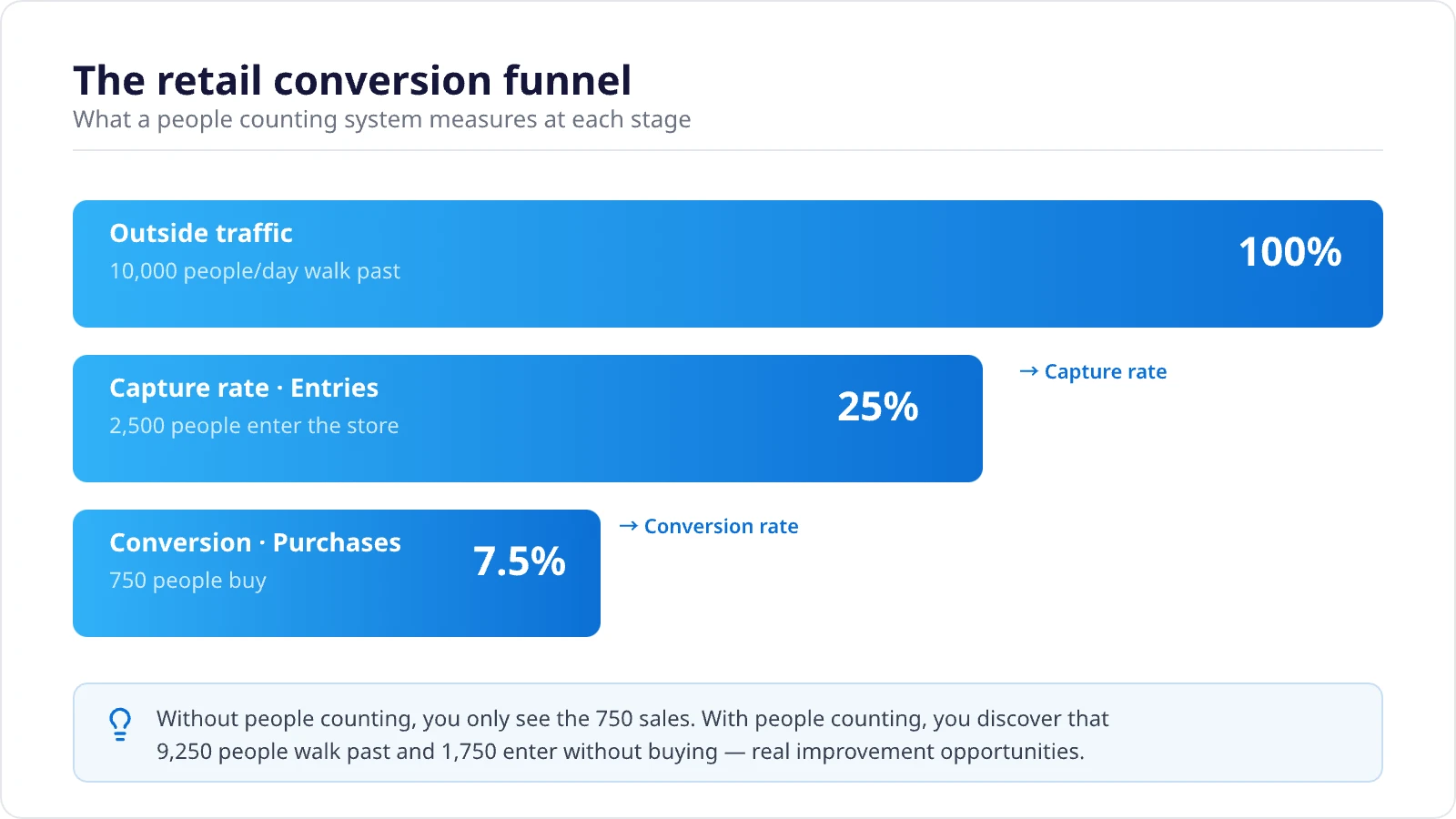
Without traffic data, a retailer can only measure the end of the funnel: sales. But sales are the result of a chain that starts much earlier: how many people walk past the store, how many enter, how long they stay, and what percentage ends up buying.
People counting unlocks metrics that were previously invisible:
1
Sales / visitors. Without counting, this KPI doesn’t exist. With counting, you can compare stores, campaigns, and periods.
2
People who enter / people who walk past. Measures the effectiveness of your window display and storefront.
3
Knowing peak and off-peak hours lets you adjust shifts to real demand, reducing costs without losing service.
4
Did that Instagram campaign drive more store visits? You only know if you measure traffic before and after.
5
Property managers use footfall data to set variable rents. Without your own data, you negotiate blind.
People Counting Technologies: Complete Comparison
 people counting technology” />
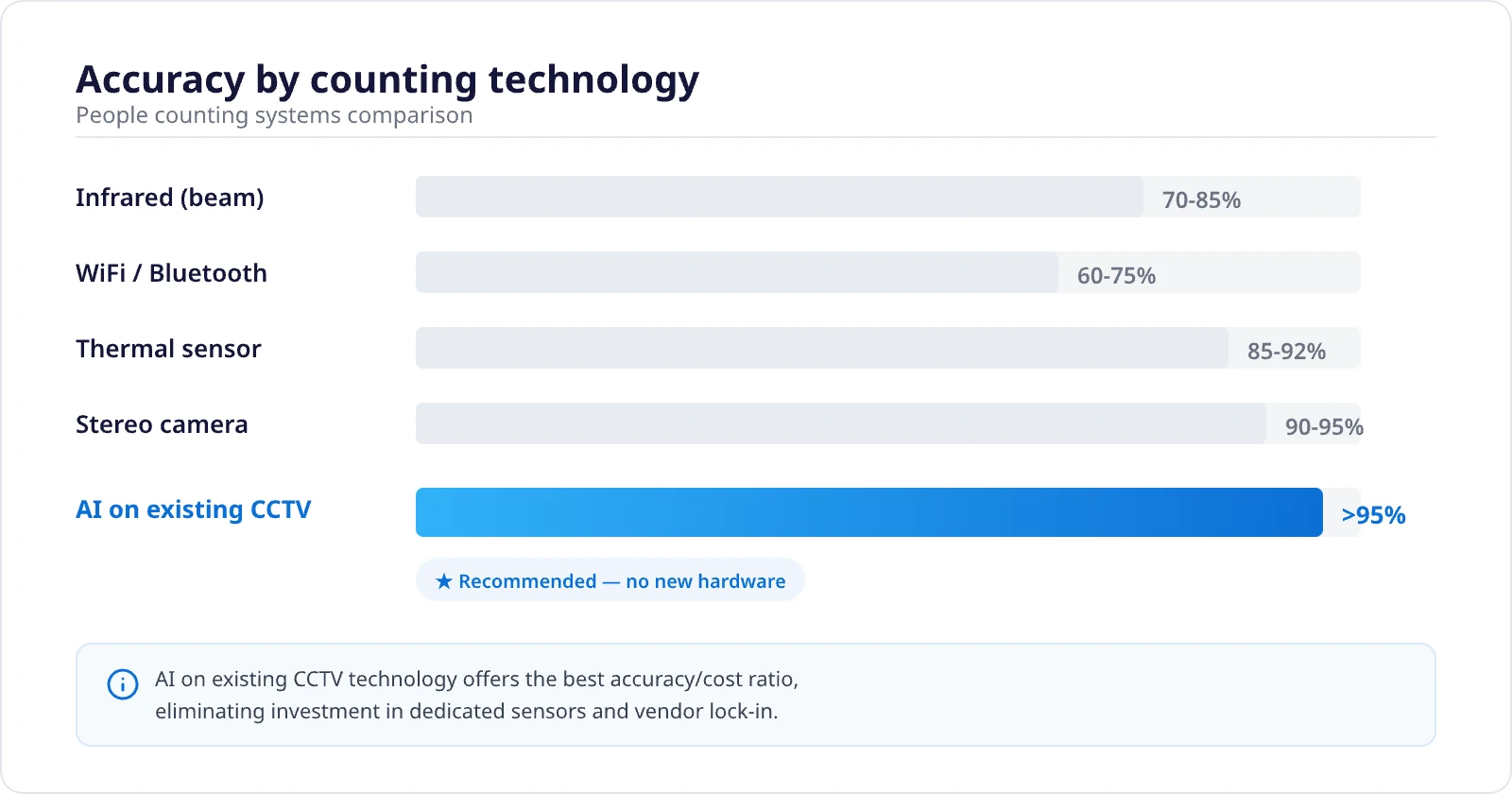
Not all people counting systems are equal. The technology you choose determines accuracy, cost, scalability, and the metrics you can obtain. Here’s an honest comparison:
Why AI on CCTV? Most retailers and shopping malls already have security cameras installed. Systems like Flame Traffic use these existing cameras for AI-powered people counting, eliminating the need for dedicated sensors. The result: equal or better accuracy than a stereo sensor, at a fraction of the cost.
Key Metrics You Get con el conteo de personas
A modern people counting system doesn’t just count — it generates a data ecosystem that feeds your entire retail strategy:
How to Choose the Right People Counting System
Before investing in a people counting system, ask yourself these five questions:
1
Do you already have CCTV cameras?
If the answer is yes (and for 95% of retailers it is), you can use an AI-based CCTV system like Flame Hypersensor and save on purchasing dedicated sensors.
2
How many measurement points do you need?
A store with one entrance needs one point. A mall with 20 entrances needs 20. The cost per point varies enormously by technology.
3
What metrics do you need?
If you only need basic counting, an infrared sensor may suffice. If you need capture rate, heatmaps, dwell time and occupancy, you need an AI solution.
4
5
Integration with your existing systems?
Can your POS, ERP, or BI platform receive traffic data? Look for a system with an open API and automated data export.
Implementing a People Counting System: Step by Step
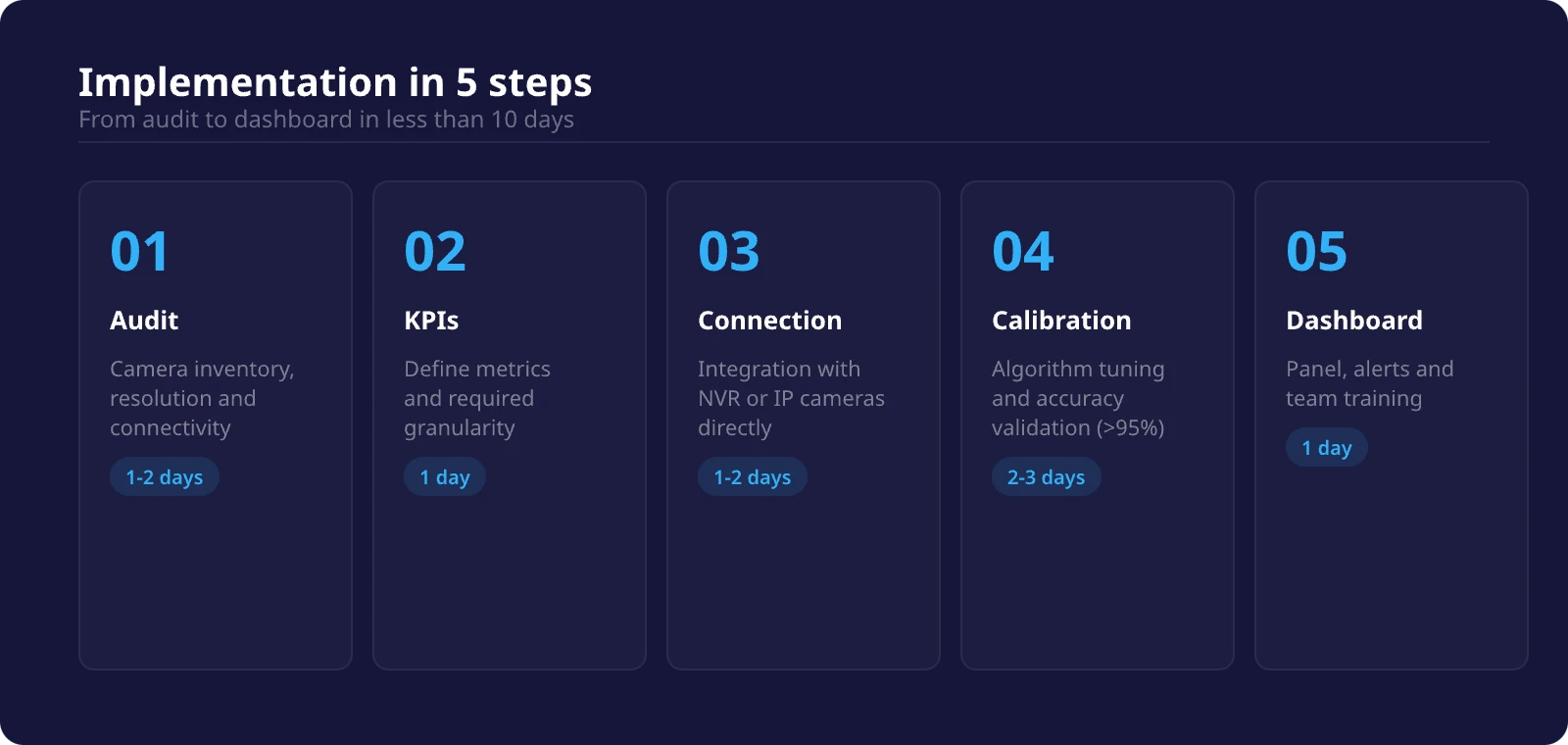
With an AI-based CCTV system, implementation is considerably faster than with dedicated sensors:
Total time: 5-10 business days for a single store. 4-6 weeks for a shopping mall network deployment with multiple measurement points.
People Counting Use Cases by Industry
Fashion chain with 120 stores implements people counting to measure capture rate per window display. They cross-reference traffic data with visual merchandising changes to identify which designs generate more entries.
Result: +18% average capture rate in 6 months.
Shopping mall group with 50+ assets uses people counting to generate weekly footfall reports by zone, year-over-year comparisons, and cross-center benchmarking.
Result: rent negotiations based on real data, not estimates.
Supermarket chain uses people counting to optimize staff shifts. They correlate hourly traffic curves with assigned staff to eliminate overstaffing during off-peak hours.
Result: -15% staff costs with no impact on customer experience.
Museum implements people counting for real-time capacity management and visitor flow analysis between rooms. Identifies exhibitions with highest and lowest attraction.
Result: exhibition redistribution that increased average visit time by 22%.
People Counting ROI: How Much You Can Save
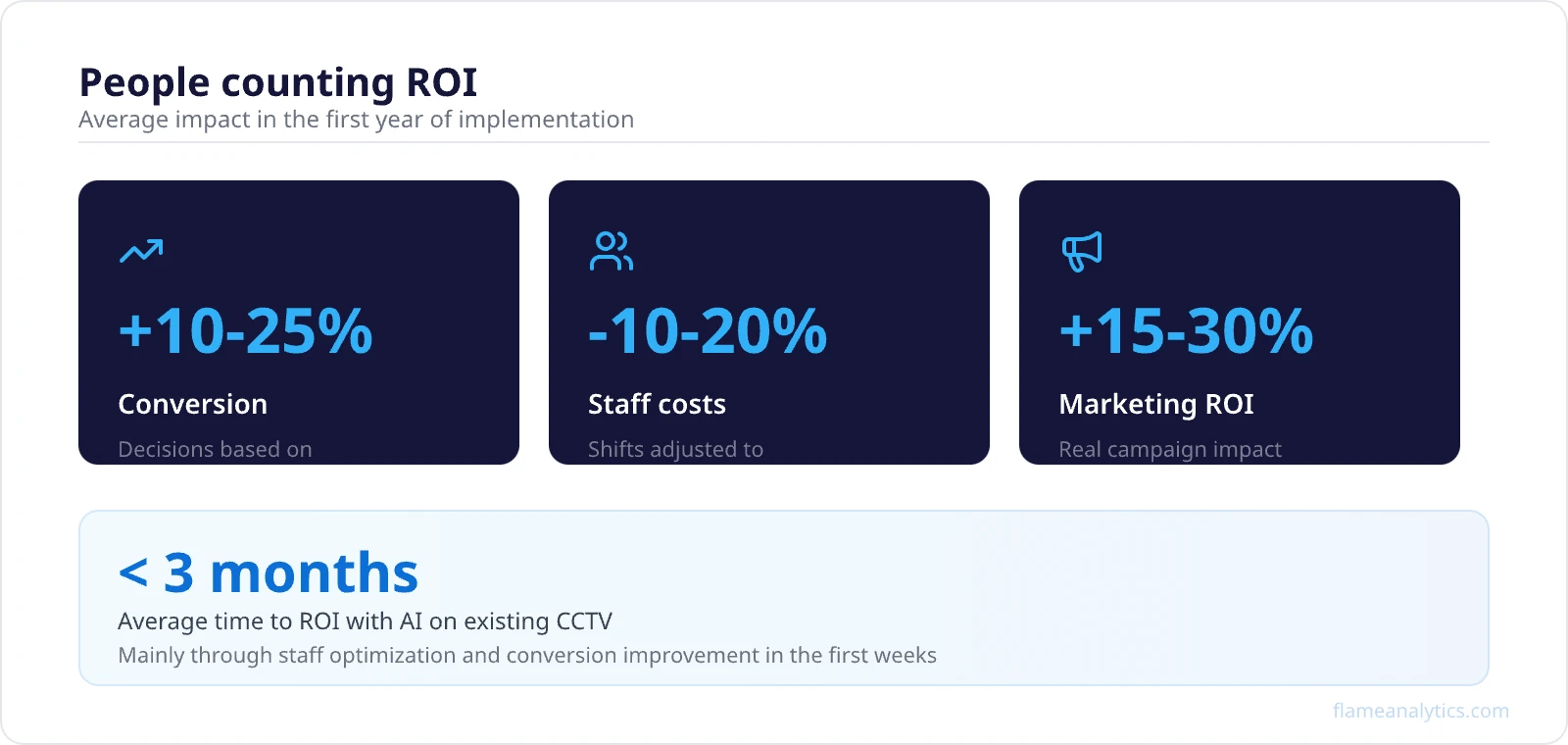
The return on investment of a people counting system materializes in three main areas:
La mayoría de implementaciones de conteo de personas alcanzan el ROI dentro del primer trimestre, especialmente cuando se utiliza un sistema basado en AI on existing CCTV que no requiere inversión en hardware.
FAQ sobre conteo de personas
How much does a people counting system cost?
Depende de la tecnología. Un sensor infrarrojo básico cuesta 100-300€. Un sensor estereoscópico dedicado, 500-2.000€ por punto. Un sistema basado en AI on existing CCTV como Flame elimina el coste de hardware — solo pagas la licencia de software.
How accurate is AI-based people counting?
Over 95% under normal conditions. Algorithms include automatic staff exclusion, group detection, and double-counting correction with overlapping cameras.
Does people counting comply with GDPR?
It depends on the system. Those using facial recognition or biometrics fall into the high-risk category. Flame Hypersensor operates exclusively with silhouette detection and anonymous aggregated data — full GDPR and EU AI Act compliance.
Can I use my current security cameras?
Yes, if they are IP cameras with RTSP or ONVIF protocol. This includes virtually all cameras installed in the last 10 years: Hikvision, Dahua, Axis, Bosch, Hanwha, and any compatible model.
How long does implementation take?
With an AI-based CCTV system: 5-10 business days for a store, 4-6 weeks for a shopping mall network. With dedicated sensors, the timeline doubles due to physical installation.
Ready to start counting?
Discover how many sales opportunities you’re losing every day. Request a demo and start measuring your business’s real traffic.
 People Counting
 Conversion Analytics
 Customer Behavior
 Occupancy Management
 Queue Analytics
 Restroom Management
 Guest Wifi Marketing
 Corporate WiFi Access
 Retail
 Shopping malls
 Hospitality
 Public Venues