
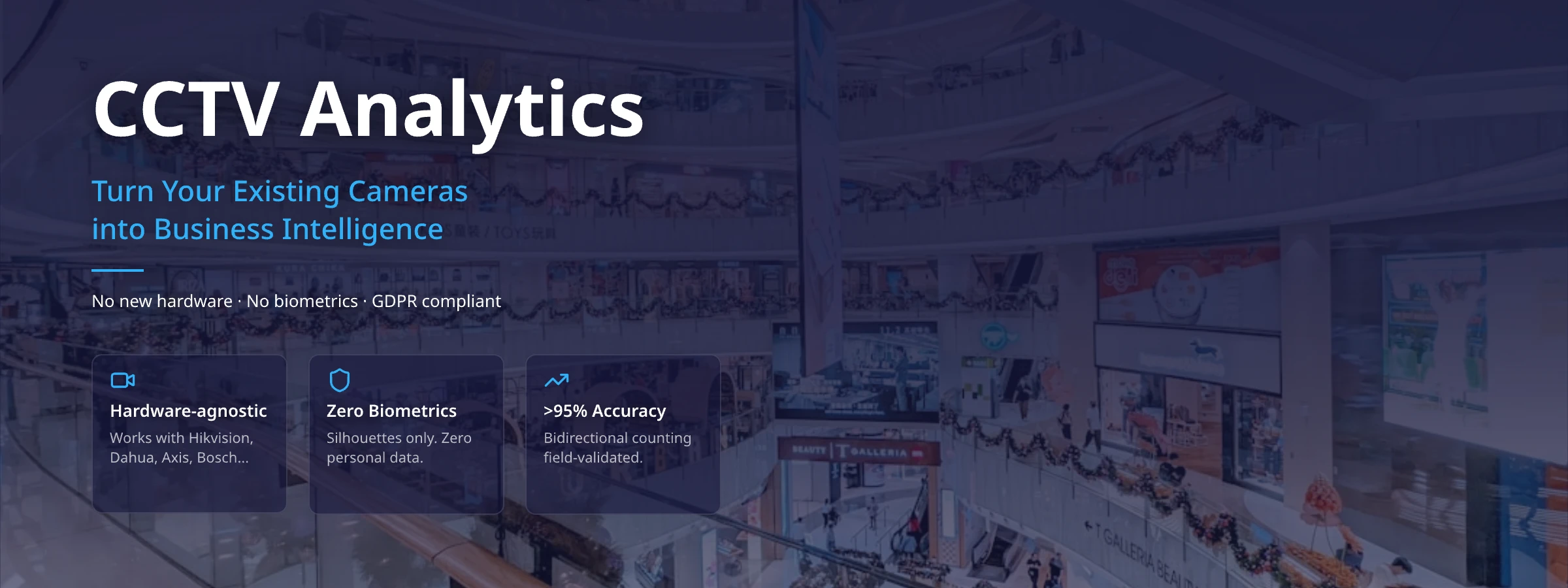
Your business already has security cameras. They’ve probably been mounted on the ceiling for years, recording hours of footage nobody watches. But what if those same cameras could tell you how many people enter each hour, which zones they ignore, and why 40% of your visitors leave without buying? That’s CCTV analytics: turning surveillance into business intelligence. With the right CCTV analytics platform, every camera becomes a data sensor.
(10 cameras × 12h)
sensors
collected
What is CCTV Analytics and why does it matter for retail?
CCTV video analytics is the use of artificial intelligence to extract business information from closed-circuit camera video feeds. In retail, it means transforming security footage into actionable data about visitor behavior. Modern CCTV analytics solutions use computer vision and machine learning to deliver insights that were previously impossible without dedicated hardware.
Unlike a traditional video surveillance system — which only records and stores — video analytics processes images in real time to detect patterns: people flows, dwell times, hot zones, queues, conversion rates and more. This makes CCTV analytics one of the most cost-effective tools for retail intelligence.
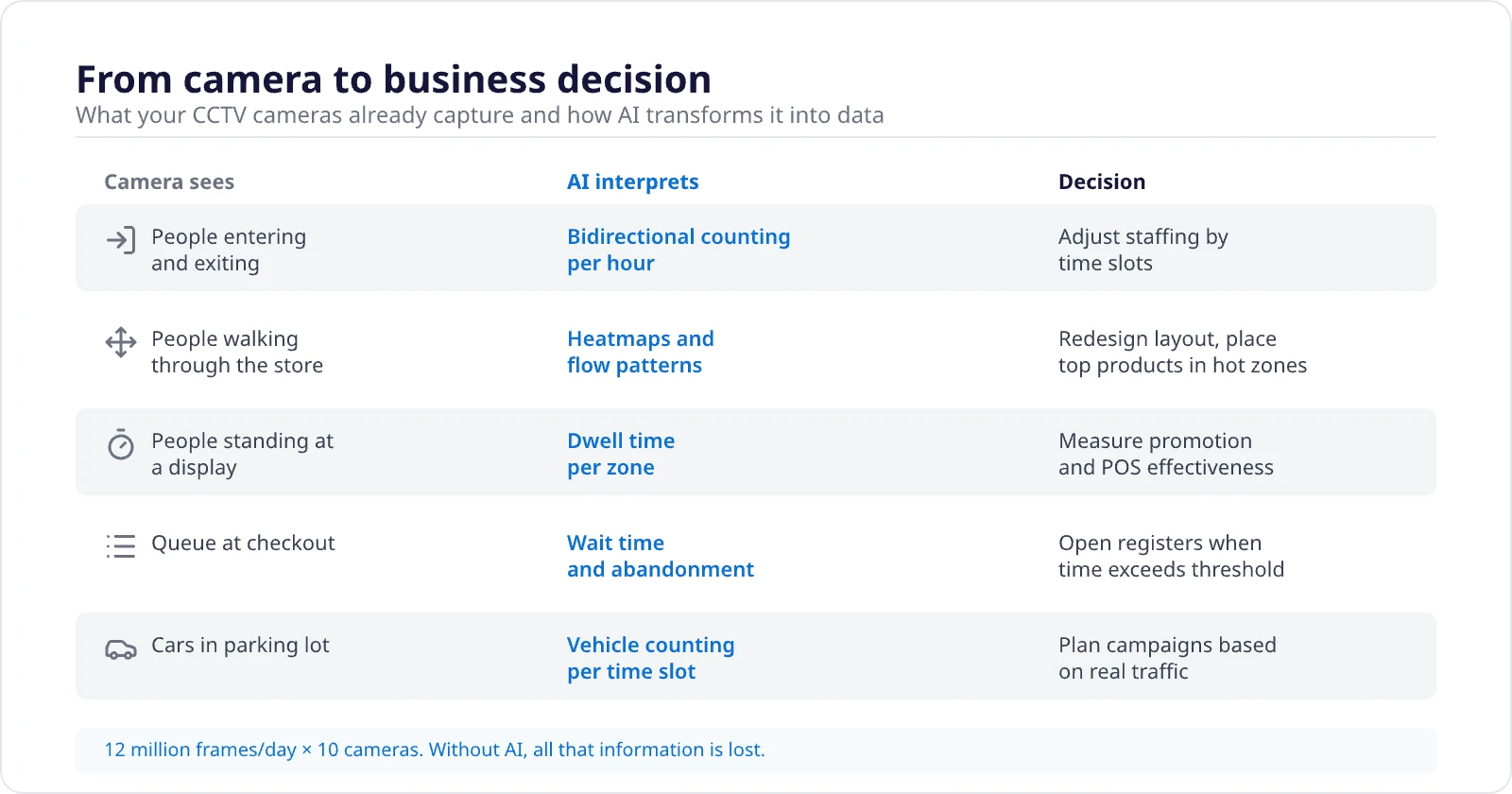
Key fact: A standard CCTV camera generates 15-30 frames per second. In a store with 10 cameras operating 12 hours a day, that’s over 12 million frames daily. Without analytics, all that information is lost on a hard drive.
What your cameras already capture (and you’re not using)
The proprietary hardware problem
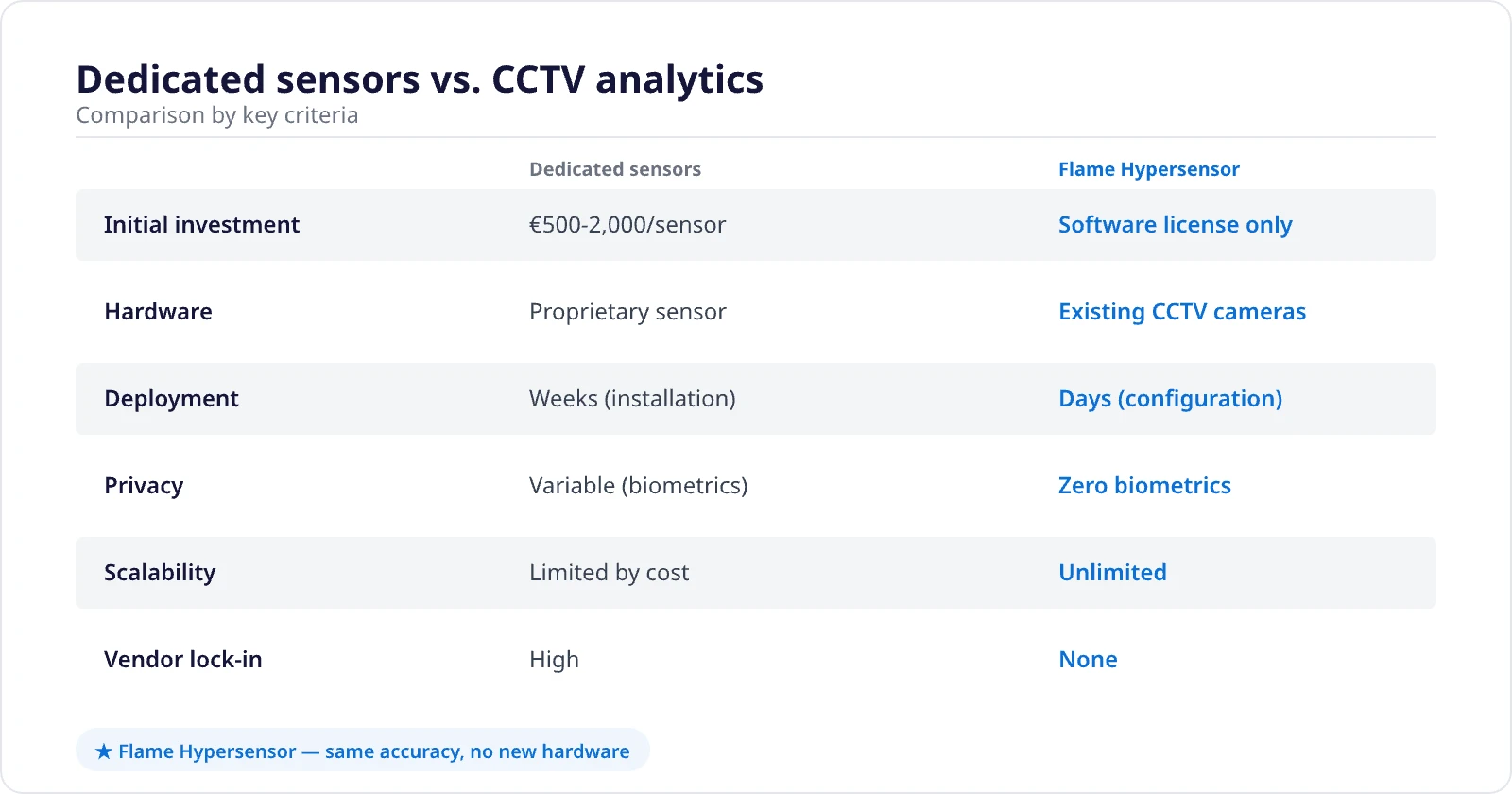
Historically, implementing visitor analytics required purchasing dedicated sensors: infrared, stereo cameras, or BLE beacons. Providers like RetailNext (Aurora sensor), V-Count (Ultima AI), or Sensormatic (ShopperTrak) sell both software and hardware. Meanwhile, CCTV analytics platforms like Flame Hypersensor work with existing infrastructure.
This creates three concrete problems:
1
Each dedicated sensor costs between €500 and €2,000 per measurement point, multiplied by every entrance, zone, and floor.
2
95% of retailers already have CCTV cameras. Installing proprietary sensors means adding redundant hardware.
3
Proprietary hardware ties you to the vendor. Switching platforms means replacing sensors.
The hardware-agnostic CCTV Analytics approach: use what you already have
The alternative is an analytics platform that works on existing CCTV cameras. This is the approach Flame Analytics implements with Hypersensor: an AI engine that connects to the video feed of any IP camera (Hikvision, Dahua, Axis, Bosch, Hanwha, or any ONVIF model) and extracts the same data — or more — as a dedicated sensor. This CCTV analytics approach eliminates the need for proprietary hardware entirely.
Privacy and GDPR: the decisive factor in 2026
When discussing AI-powered video analytics, the first question is always the same: does this CCTV analytics technology comply with data protection regulations? The GDPR and, since 2024, the EU AI Act classify biometric identification systems in public spaces as high-risk technologies or outright prohibited.
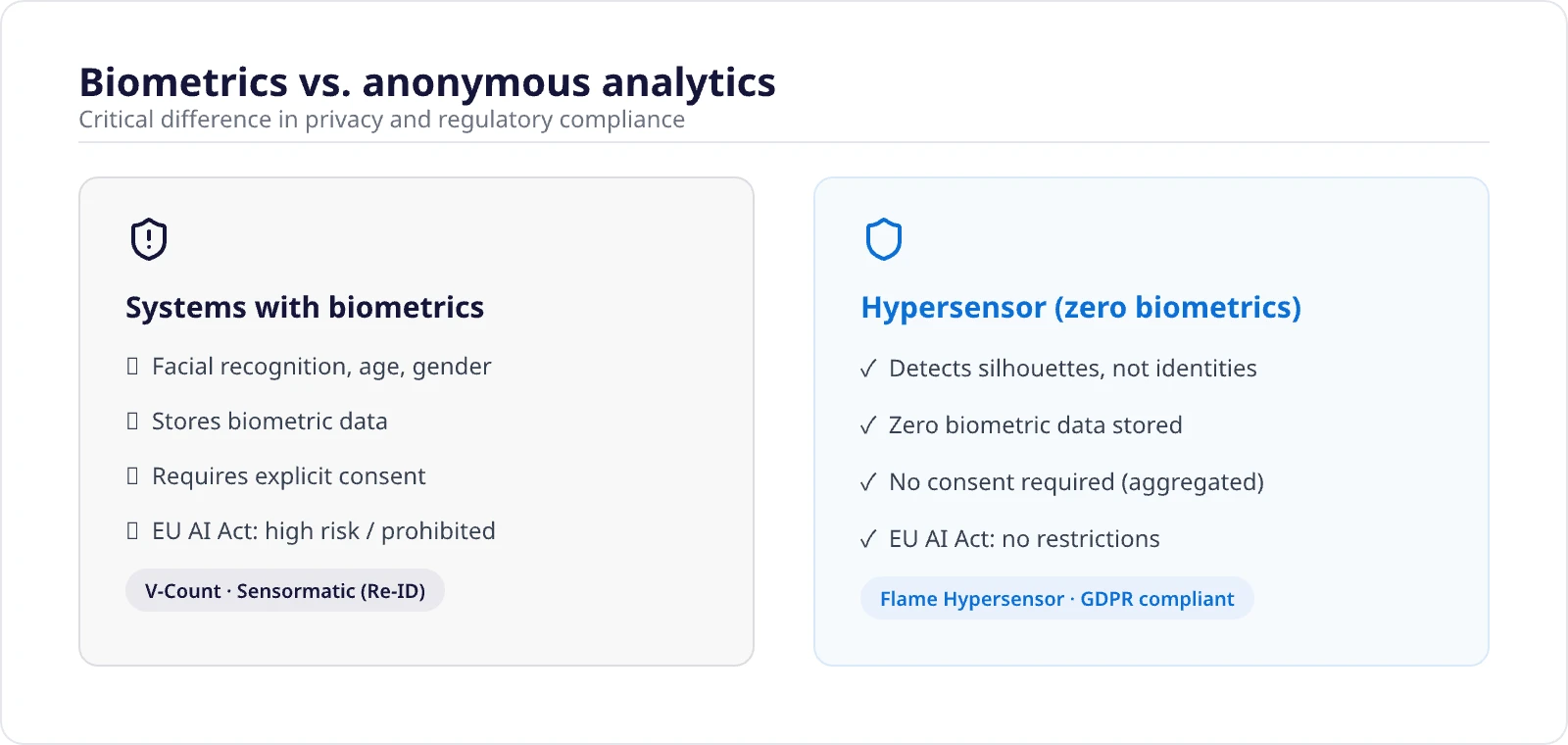
Biometrics vs. anonymous analytics
Key differentiator: V-Count offers age and gender estimation (biometric data under GDPR). Sensormatic uses Re-ID (cross-camera re-identification). Both enter a legal gray area. Flame Hypersensor operates exclusively with silhouette detection and anonymous tracking: zero biometrics, zero personal data, zero regulatory risk.
How CCTV Analytics works: from camera to dashboard
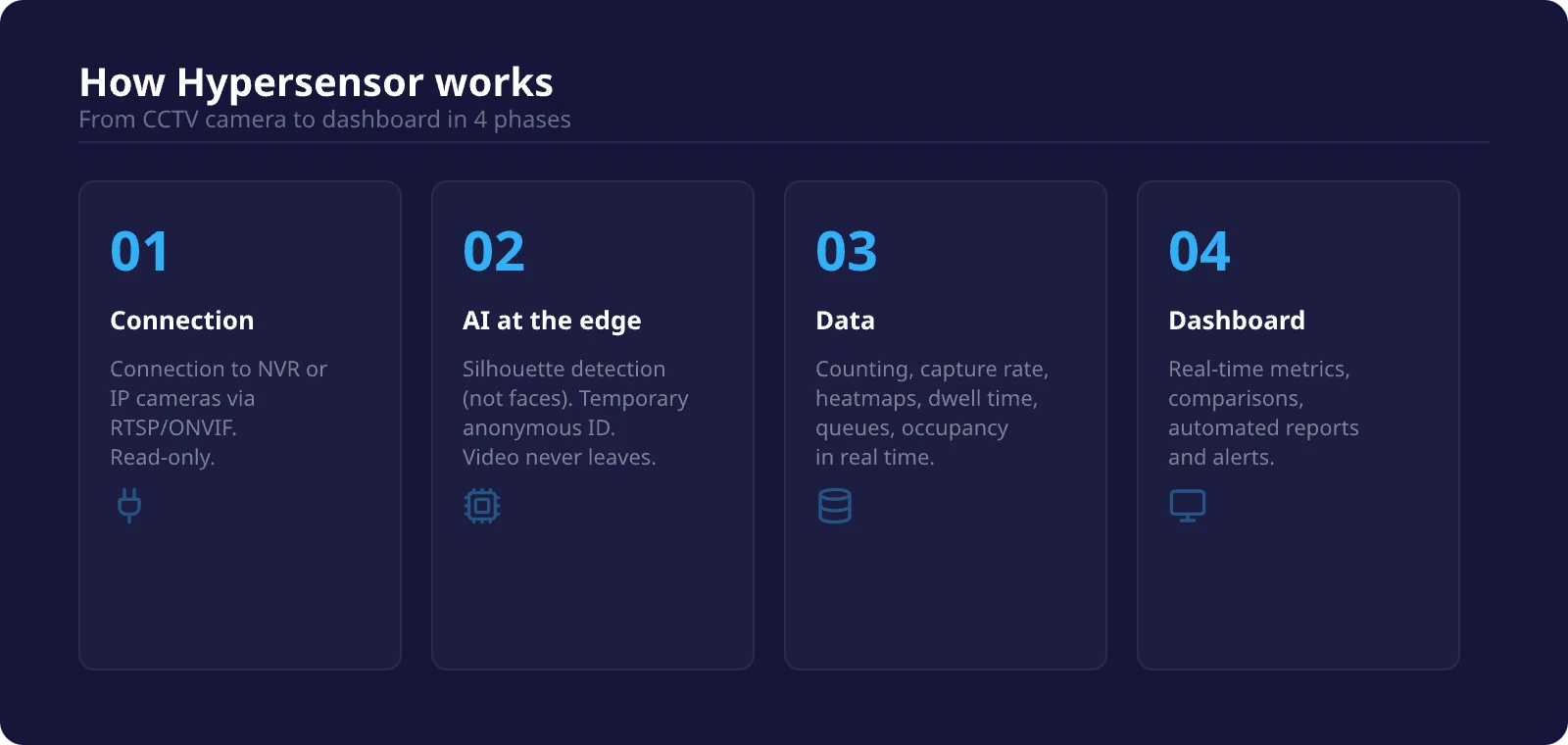
The process of converting CCTV video into business intelligence can be summarized in four phases:
1
Connection to the video feed
Hypersensor connects to the NVR or directly to IP cameras via RTSP/ONVIF protocol. No physical access or security system modification required. The connection is read-only.
2
AI processing at the edge
Computer vision algorithms detect human silhouettes (not faces) and assign a temporary anonymous identifier for path tracking. Processing runs at the edge (local server), so video never leaves the premises.
3
Structured data generation
Real-time metrics are extracted from video: bidirectional counting, capture rate, heatmaps, dwell time, visitor flows, queue detection, vehicle counting, and real-time occupancy.
4
Dashboard and alerts
Todos los datos se visualizan en el dashboard de Flame Analytics. Métricas en tiempo real, comparativas por periodo, informes automáticos y alertas configurables (ej: “cola > 8 personas durante > 3 minutos”).
5 Real-world use cases
A shopping mall with 50+ stores uses hourly counting data to recommend staffing levels per time slot to each tenant.
Result: -15% staff costs during off-peak hours with no impact on experience.
A fashion chain measures the ratio of passers-by vs. those who enter each store, cross-referencing with window display changes.
Result: +23% capture rate with the campaign’s winning window display.
A hypermarket discovers that 60% of customers never reach the back. It reorganizes higher-margin categories to high-traffic zones.
Result: +8% average ticket in the following quarter.
Supermarket chain with automatic alerts: if there are more than 5 people in queue for over 2 minutes, the floor manager is notified.
Result: -35% average wait time.
A shopping mall group generates automatic weekly reports with footfall by zone, year-over-year comparisons, and cross-center benchmarking. Property managers negotiate rents based on real data.
Result: negotiations based on real traffic data, not estimates.
Comparison: dedicated sensors vs. CCTV analytics
How to implement CCTV analytics in your business
If your business already has security cameras (and statistically, if you have a physical space open to the public, you do), the process is simpler than you think:
1
Existing camera audit
Inventory review: models, resolution, angles, and connectivity. Most IP cameras from the last 10 years are compatible.
2
KPI definition
What do you need to measure? Counting, heatmaps, queues, occupancy, capture rate… Every business has different priorities.
3
Hypersensor connection
The AI engine connects to the NVR or cameras directly. No construction, no additional wiring, no interruption to recording.
4
Calibration and validation
Se ajustan los algoritmos a las condiciones de cada cámara y se valida la precisión (>95% en condiciones normales).
5
Dashboard and training
The dashboard is configured with defined KPIs and the team is trained to interpret data and set up alerts.
Implementation timeline: 5-10 business days for a single store. 4-6 weeks for a shopping mall network deployment. Most CCTV analytics implementations achieve ROI within the first quarter through staff optimization and conversion improvements alone.
Frequently asked questions
Do I need to replace my current security cameras?
In most cases, no. Hypersensor is compatible with any IP camera that supports RTSP or ONVIF, which includes virtually all cameras installed in the last 10 years (Hikvision, Dahua, Axis, Bosch, Hanwha, etc.).
Does video analytics comply with GDPR?
It depends on the system. Those using facial recognition or biometrics fall into the high-risk category. Hypersensor operates exclusively with silhouette detection and anonymous aggregated data, without collecting any personal data. Full GDPR and EU AI Act compliance.
How accurate is the counting?
Over 95% under normal operating conditions. The system includes automatic staff exclusion, group detection, and double-counting correction in environments with overlapping cameras.
Is the video sent to the cloud?
No. All processing runs at the edge (local server at the premises). Only structured data (numbers, metrics, alerts) is sent to the cloud dashboard. Video never leaves the store.
Your cameras are already smart. They just need the right software.
Discover how to turn your existing CCTV infrastructure into a business intelligence tool. No new hardware, no biometrics, powered by AI.
 People Counting
 Conversion Analytics
 Customer Behavior
 Occupancy Management
 Queue Analytics
 Restroom Management
 Guest Wifi Marketing
 Corporate WiFi Access
 Retail
 Shopping malls
 Hospitality
 Public Venues