
 people counting heatmaps computer vision” />
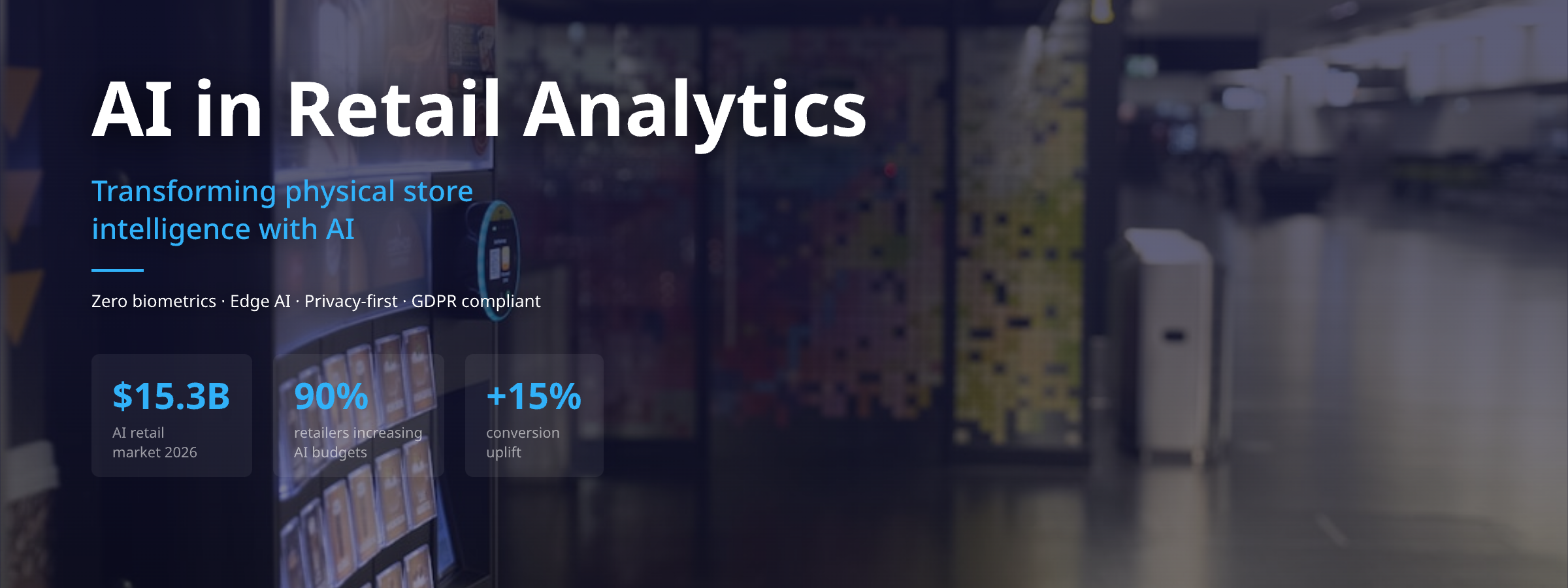
AI in retail analytics means applying machine learning and computer vision to the data generated inside physical stores — footfall, movement patterns, dwell time, zone occupancy — to make decisions that were previously based on instinct. Unlike ecommerce, where AI has been standard practice since the 2010s, physical retail is only now reaching the same data maturity. The gap between digital and physical store intelligence is closing fast, and the retailers who close it first have a structural advantage that is very hard to replicate.
The Physical Store Data Gap No One Is Talking About
Every article about AI in retail defaults to ecommerce examples: recommendation engines, dynamic pricing, inventory automation. These are real applications — but they describe a world that already has good data. The more consequential story in 2026 is what AI is doing for the 80% of global retail that still happens in physical spaces.
A store manager running a 1,200 sqm fashion outlet in 2024 knew their daily sales figures and maybe had a door counter. Everything else — how customers moved through the store, which fixtures attracted attention, where conversion broke down, how a promotion actually affected traffic flow — was invisible. That manager was operating with a fraction of the data available to a mid-size Shopify store.
AI is now the mechanism that closes that gap. Not through theoretical transformation, but through applied tools that layer intelligence on top of infrastructure that most stores already have: surveillance cameras, WiFi access points, and entrance sensors.
Key point: Most physical stores already own the hardware required for AI analytics. The transformation is a software layer on existing cameras — not a capital replacement project.
How AI Video Analytics Works in Physical Stores
AI video analytics for retail uses computer vision models — typically running at the edge, on devices installed close to the cameras — to process video feeds in real time and extract behavioral data without storing or transmitting identifiable images.
The process has three stages. First, the computer vision model detects and counts silhouettes — not faces, not individuals — as they enter, move through, and exit defined zones. Second, the aggregated behavioral signals (zone occupancy over time, dwell duration, directional flow, queue length) are structured into a data layer. Third, that data layer feeds dashboards, alerts, and predictive models that store managers and operations teams actually use.
Edge AI vs. Cloud Processing
Edge AI is the architecture that makes privacy-compliant retail analytics possible at scale. By running the computer vision model on a local device rather than uploading footage to a cloud server, the system processes and discards the raw video immediately. What leaves the store is aggregated counts and behavioral vectors — not images, not biometric data, not anything that can be traced back to an individual.
This approach also reduces bandwidth costs, lowers latency for real-time alerts, and eliminates the security risk associated with storing video footage remotely. For multi-site retail operators, edge AI makes large-scale deployment significantly simpler than cloud-dependent architectures.
Flame’s Hypersensor is built on this edge AI principle — zero biometrics, zero raw video storage, full behavioral intelligence delivered to the analytics dashboard.
Key Use Cases: From People Counting to Predictive Footfall
AI analytics in physical stores is not a single capability — it is a stack of use cases that build on each other. The entry point is accurate people counting; the ceiling is real-time operational intelligence.
| Use Case | What AI Does | Business Output |
|---|---|---|
| People counting | Computer vision counts entrances and exits with 95–99% accuracy | Reliable conversion rate, staff-to-visitor ratio, campaign measurement |
| Heatmaps & zone analytics | Tracks aggregate movement patterns and time spent in each zone | Store layout optimization, dead zone identification, product placement |
| Customer journey analysis | Maps sequential zone visits and dwell time at category level | Promotion sequencing, cross-category triggers, experience design |
| Queue detection | Detects queue formation and length in real time | Dynamic staffing alerts, abandonment reduction, customer satisfaction |
| Predictive footfall | ML models forecast traffic by hour using historical + external variables | Proactive staffing, optimized opening hours, promotional timing |
| Campaign attribution | Correlates marketing investment with footfall increments | Proven ROI per channel, budget optimization, tenant reporting |
What Sets Physical Store AI Apart
Ecommerce AI is largely about individual-level personalization: this user, this session, this recommendation. Physical store AI operates differently. Because it works without identifying individuals, it generates aggregate behavioral intelligence — patterns, flows, anomalies — that informs decisions at the store and portfolio level rather than the individual transaction level.
This aggregate model is not a limitation. For most retail decisions — floor layout, staffing schedules, promotional calendar, category placement — aggregate behavioral data is exactly what is needed. And it is generated continuously, passively, at a cost per insight that manual observation cannot approach. Traffic analytics platforms consolidate this data into a single operational view across single and multi-site operations.
Privacy-First AI: GDPR Compliance Without Compromise
The most common barrier retailers cite when evaluating AI video analytics is not cost — it is regulatory risk. GDPR and its equivalents create real constraints on how video data can be collected, processed, and stored. The answer is not to avoid AI analytics; it is to choose an architecture that was designed from the start to operate within those constraints.
Privacy-first AI video analytics has three characteristics: no facial recognition, no biometric data processing, and no individual tracking. The system counts and analyzes behavioral patterns at aggregate level only. Raw video is processed locally and never retained. The output — footfall counts, zone dwell times, movement flows — contains no personally identifiable information by definition.
This is not a compromise. Retailers do not need to identify who is walking through the door to optimize how they design, staff, and promote their stores. Aggregate behavioral data is sufficient for every major use case. The GDPR compliance framework for retail video analytics is clear, and modern platforms are built to operate cleanly within it.
Zero biometrics principle: Flame Analytics processes no biometric data. No faces are recognized, no individuals are tracked. Behavioral intelligence is derived entirely from aggregate, anonymized signals — making it compliant by architecture, not by policy.
Measuring ROI on AI Retail Analytics
ROI from AI analytics in physical stores comes from four sources: operational savings, conversion improvement, promotional efficiency, and real estate decisions. The first two tend to generate the fastest returns.
Staffing Efficiency
Labour is typically the largest controllable cost in retail operations. Predictive footfall models allow managers to align staffing levels with expected traffic, eliminating the overstaffing during slow periods and understaffing during peaks that erode both margin and customer experience simultaneously. Retailers using AI-driven workforce scheduling consistently report 8–12% reductions in labour cost without service level deterioration.
Conversion Rate Improvement
Conversion rate — the percentage of store visitors who make a purchase — is the single most important metric in physical retail that most retailers do not measure accurately. Without reliable people counting, conversion rate calculations are estimates at best. With AI-accurate footfall data, retailers can identify exactly which hours, days, zones, and conditions correlate with higher or lower conversion and redesign accordingly. McKinsey data points to an average 15% conversion rate improvement from AI-driven layout changes.
Promotional ROI Attribution
For shopping centers and multi-tenant retail, proving the footfall impact of marketing investment is commercially critical. When mall operators can show tenants a direct correlation between campaign spend and traffic uplift — measured by AI people counting before, during, and after a campaign — the commercial relationship changes. Tenants who can see ROI co-invest in campaigns rather than negotiating lower rents. The analytics platform becomes a commercial asset, not just an operational tool. See how this plays out in the context of AI in shopping centers.
Frequently Asked Questions
What is AI in retail analytics?
AI in retail analytics is the application of machine learning and computer vision to behavioral data generated inside physical stores. It covers people counting, movement heatmaps, dwell time measurement, queue detection, predictive footfall, and campaign attribution — all without identifying individual customers.
Is AI retail analytics different from ecommerce analytics?
Yes. Ecommerce analytics tracks individual user sessions and transactions. Physical store AI analytics works at aggregate level — it measures flows, patterns, and occupancy across a population rather than individual clickstreams. This makes it privacy-compliant by design, but it also means the decisions it informs are primarily operational and spatial rather than individual and transactional.
Does AI video analytics require replacing existing cameras?
In most cases, no. Modern AI video analytics platforms are designed to layer intelligence on top of existing CCTV infrastructure. The AI model runs on an edge device that connects to existing camera feeds, eliminating the need for a full hardware replacement. This dramatically reduces deployment cost and time-to-value.
Is AI retail analytics GDPR compliant?
It can be, and the best platforms are designed specifically for GDPR compliance. The key criteria are: no facial recognition, no biometric data processing, no individual tracking, and no raw video retention. When these conditions are met, there is no personal data processing and therefore no GDPR exposure. See our detailed GDPR guide for retail video analytics.
Which types of retailers benefit most from AI analytics?
Any physical retail format where footfall volume, store layout, staffing cost, or promotional effectiveness are material business variables. In practice, this means fashion, grocery, sports, electronics, home improvement, and shopping centers. The ROI case is strongest for multi-site operators, where a consistent data infrastructure unlocks portfolio-level insights and benchmarking.
See how Flame Analytics measures your store intelligence
People counting, heatmaps, predictive footfall and GDPR-compliant AI video analytics for physical retail. No biometrics. No black box.
 People Counting
 Conversion Analytics
 Customer Behavior
 Occupancy Management
 Queue Analytics
 Restroom Management
 Guest Wifi Marketing
 Corporate WiFi Access
 Retail
 Shopping malls
 Hospitality
 Public Venues